

The interview has been edited for length and clarity.
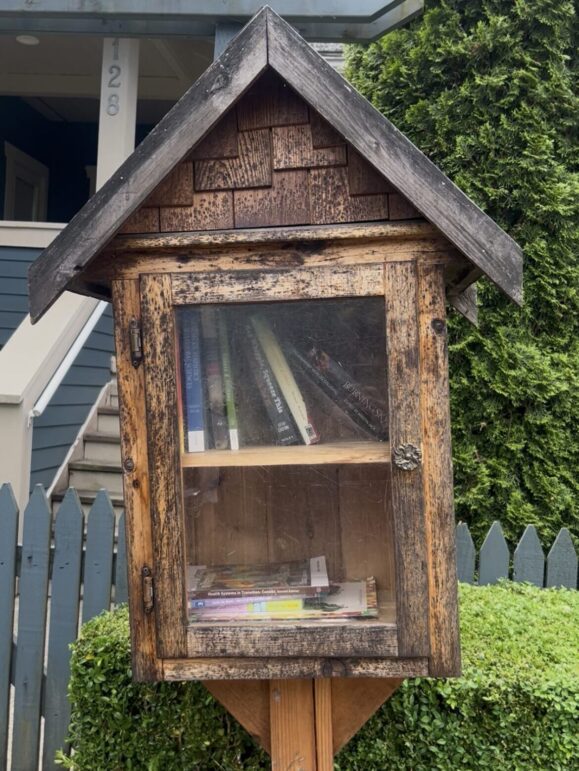
If you want to find a neighbourhood book exchange in Vancouver, all you have to do is walk a few blocks and you’re likely to hit one. I love these little neighbourhood libraries: they’re quaint, whimsical, and each one showcases the unique tastes and/or crafts skills of its owner. They are free, accessible to all, and mostly open 24/7. They invite us to pause, wander over, and get lost in the delights of their cabinet of curiosities. After a sunny walk in the neighbourhood with my friends, one of them asked, “I wonder if there’s a map of all of these.” “There must be,” I replied.
Last week I sat down with Korky Day, the infamous local legend behind Vancouver’s most extensive and detailed map of neighbourhood book exchanges, listing over 500. We shared some laughs, discussed how he got involved in this project, his favourite libraries, and some tips for maintaining your community book exchanges. Stay tuned on our socials to see where we’ve donated 16 brand new local books to neighbourhood book exchanges in Vancouver.
Tenaya Fogelman: How did you get involved with the neighbourhood book exchange map?

Korky Day: My girlfriend and I, we started walking a lot in 2020 for some reason. And then I noticed a little library and it was made of hockey sticks. And I thought, “Oh, that’s interesting. I think I’ve seen one of these before on the East Side.” So I wrote down the address and then somehow I thought of looking on the internet, and then I found a whole bunch more. There’s the official world site, Free Little Library which has about 70 within the Vancouver city limits. But the ones that I knew about, the hickey-stick one I saw, wasn’t on that map, so I thought I’ll collect some. Then I found that Georgia Straight map, which wasn’t done by the original person anymore. I joined the guy who had taken over, and then he quit, so then I was the only one left editing it. I wondered if the Georgia Straight would like to have it back. So I contacted them and they said, sure, and so we’re back under their nominal sponsorship.
TF: Are you still the main person that’s managing the map and answering inquiries?
KD: I call myself the editor of the map, or the editor-in-chief. There are no others at the moment, but there could be!
TF: Since you don’t have a cell phone, how do you use the map when you’re walking around? Is it something that you look up before and then head out?
KD: I use pen and paper when I find a new little library. And if I don’t have a piece of paper, I find an old coffee cup lying on the side of the road and I write on it. And then I go home and put it on the map. A few other people have contributed. Maybe 10% of the ones I added were ones that I’ve been tipped off by readers or people that knew I was doing this.
TF: How do you see people using the map to explore these neighbourhood book exchanges?
KD: I want it to be out there for anyone to use, but how they use it is up to them. They can carry it around on their cell phone if they want, or they can look at it at home and write down the addresses and go to them on foot or bicycle. I cycle around. I’ve been on most of the streets of Vancouver on my bicycle looking for them, which is kind of fun. It was something to do when people weren’t going indoors too much.
TF: I live in East Vancouver and I see the libraries everywhere, and I didn’t realize that there was an actual nonprofit behind some of them. They have a map, but it’s only for the ones that are registered with the organization, and there’s a whole bunch that aren’t a part of it.
I give the exact address. That’s the kind of old hippie I am.
KD: Mine has over 400 now, I think, as opposed to 70 on the official map. So there’s a story behind that too. I talked to the central organization and we decided to try an experiment with my help. I gave them all the addresses of the ones that were not on their map and they mailed them Canada Post invitations to join and be on the official map. We didn’t know how many would respond but it was an experiment worth trying, I think.
But unlike some of the other maps, I did the actual addresses. So, if you look at the Victoria map, for instance, or the North Shore one, they’ll say, “It’s at the corner of First and Main.” Well, there are usually four corners so you’ve got to traipse around, “oh, which corner is it?” No, I give the exact address. That’s the kind of old hippie I am. I used to do the coming events for the Georgia Straight and the Directory of Services. I always state the address.
TF: I noticed that it isn’t just book libraries. There are also fire sheds and other libraries.
KD: Things like pet food and food pantries, there are quite a few of those in Vancouver. My policy is that if they have books, I don’t care what else they have too. But they have to have books or be open to books. The fibre libraries, for instance, have materials, tools, and books about fibre, so I include all of them. There’s about six or eight now.
TF: Yeah, I’ve come across one before. Other than the hockey stick one, because I know that one stood out for you, do you have any other favourite little libraries?
KD: Well, my favourite was the biggest, but they had to close because the owners lost the house where they were living in, they got evicted. The library was a walk-in shed, small, but it was bigger than any other one in Vancouver. My second favourite was the busiest one, which was in the West End, but they’ve closed down, too. There used to be a line-up there. I like the free stores because I find a lot of things in my travels that are good and that people have thrown away or dropped at the side of the road. And so I like to take them to free stores. Thrift stores throw things out if they’re not in top condition. But the free stores will take them.
T: Is the free aspect also what drew you to the neighbourhood libraries?
K: Well, yeah, I like that! I buy used books, too. And new books. Yeah, but free is good. So the little libraries, the vast majority are outside, so you can use them 24 hours. Sometimes you might need a flashlight. Although a couple of them are lit electrically. There’s one on W. 31st Avenue that’s lit inside.

T: What I really love about them is that it feels like a real community effort, as well as an outlet of creativity when people make their own and have fun with it. It’s something that we don’t see enough of in Vancouver sometimes.
KD: There’s one that’s about a 5-centimetre cube in the West End and it’s kind of an art joke. There’s a lot of creativity that goes into them. A popular theme is to make the little library look like their [the address’s residents’] own house. The same paint job and such. For example, the little library at a church looks like the church with the cross on it and everything.
TF: Do you have a memorable book that you’ve picked up from a library?
KD: Somebody had photocopied a book, and it was not stapled but tied together somehow. It was a photocopy of Donald Trump’s niece’s book, dissing her uncle. I read it and it was amusing.
T: There’s something interesting about how the books there are ones that wouldn’t be accepted by big libraries, or wouldn’t be accepted by thrift stores and in that way there’s this kind of freedom.
K: Right. For the vast majority, yes. But there’s some of the little libraries that say, no textbooks or no religious books, or so on. But the vast majority are open to anything.
TF: Are there any plans for when you retire? Is there someone that will take over the Vancouver map?
KD: No idea. But now that it’s part of the Georgia Straight again, they might say, “Oh, Korky retired, anybody else want to do it?” Or at least it’ll still be there. Not edited, but most of it will stay the same for quite a while, I assume. You want to do it next?
TF: Maybe we’ll see! Do you have any advice for anyone that would want to take on the same project in their own city?
KD: Well, look at mine and copy me! For instance, I have different colours for the markers on the map, and there’s a guide to what each colour means. There’s a colour for indoor ones, there’s a colour for ones that aren’t there anymore. And you might wonder, why would anyone want to know where there used to be a little library? Well, it’s so that they don’t contact me and say, “Well, you forgot the one at such and such a place”. And then I have to write to them and say, ”Oh, you didn’t look lately, it’s not there anymore.” And if it comes back, then I’ll change it back to the ‘open’ colour.
TF: So it also works like an archive.

TF: Do you feel like the little Free Libraries is a form of activism work as well?
KD: Right, but the risk of arrest is a lot less.
KD: Another thing on my map is that I warn people if some of them are not watertight. Oh, another favourite of mine is at Woodland Park because it’s big—it’s taller than me with a whole bunch of different doors to open. It’s in the park and in a poor area, so the books go fast. That’s one I put [books] into regularly.
TF: So this was a project that you got into because you were walking around and biking a lot, and also it was something that existed which then you added to?
KD: Yes, sustaining a project that someone else started using my particular skills of meticulousness, which I had used at the Georgia Straight, 50 some years ago, and all my life.
TF: Do you think that collaboration is key to keep something like this going?
KD: Well, yeah, because I’m not gonna do it forever. But it’s also something that one person can do for a particular time. Now I start Facebook groups and people ignore me almost as much as when I started real groups.


TF: Do you have any advice for people donating books? Are there specific ones you recommend people should drop them off at?
KD: Any one they want on my map! I do say, whether it’s small, medium or large, so they can consult my map if they want to see about sizes. Another thing that you can do is if you go back a month later and the books are the same, take half of those books out, take them to another little library on the other side of town, and trade them. You can bring back fresh stock for yourself and leave fresh stock for the other one.
TF: Like a community librarian.
KD: Kind of, yeah, but don’t cheat. Don’t just take the best books! Pick them at random is my advice.
TF: Do you feel like maintaining these neighbourhood little libraries is a form of activism work as well?
KD: Yes, but the risk of arrest is a lot less.

Korky Day is an old hippie activist surviving because he doesn’t take dope or eat junk. Established Wreck Beach as a free beach in 1970. Georgia Straight, Co-op Radio, Fringe Festival. Thrown out of those and other groups for radicality and invention. People fear new ideas, he says. Tries to help politicians of every stripe, but they’d rather fail. Now building a Web service for discussion, debate, and dispute resolution.

Tenaya Fogelman is a writer and editor for Read Local BC who values individual voices and local initiatives that enliven our province. Her formal role is Communications and Marketing Content Coordinator for Books BC. She received her degree in Industrial design at Emily Carr University of Art and design, where she was an event assistant for the On Edge Reading Series.