

The following interview is part one of an eight part series of conversations with BC poets. All interviews were conducted by Rob Taylor.
They Wrote the Old Pastorals from the City
They wrote the old pastorals from the city.
A dovecote purring on the roof above.
Roaches hugging the baseboards.
They knew the past belonged to history,
the present to confession, the future
to clairvoyance, but right beside the three
there sometimes ran a river
you could sometimes walk on,
rarely keeping up. They sat in cramped
apartments, looked at their wool-spun clothes,
pictured the sheep and were suddenly naked.
It was mackerel and spelt bread for lunch.
A cloacal swelter greasing the nostrils.
Day-drinkers barked smut from the street.
A supper of crumbs and diluted garum.
It was wild to think of the forum a thousand
years from then, the cows not yet cattle,
and everywhere fields that were full
with the volume of dawn, tuning
like an orchestra before the conductor
appears. It was here but never again,
and the poems a kind of astronomy
but elegy. For the helmsman cleaving
westward, the stars and planets
guiding, but never to themselves.
Reprinted with permission from
Devotional Forensics
(Goose Lane Editions, 2025)
Rob Taylor: In “They Wrote the Old Pastorals from the City,” the second poem in your debut collection, Devotional Forensics, you write “the poems a kind of astrology / but elegy.” A few poems later you write “There’s a kind of religion in thinking / about things that have gone away.” I was reminded of the words of Stephanie Bolster who spoke of the “presentiment of loss” in Don Coles’ poetry. Your poems are preoccupied with history: past events, past writings and peoples, even the origins of individual words. Do you, like Coles, see things that are here now as in the process of going away?
Joseph Kidney: In many ways, T. S. Eliot, both as a poet and a critic, has remained a touchstone (or indeed a proof-rock) for me, especially his idea of the “historical sense” a poet should cultivate (“a perception not only of the pastness of the past, but its presence”). I think we think about the past as that which is behind us and becoming more and more behind us. Yet everything is hurtling towards it as a kind of destination. You could even say that the future is so speculative and spectral, and the present so brief as to hardly merit attention, that all we really have to sit and consider is the past, whose visibility, though in no way assured, it is our task to fortify. I suppose, then, that things could be seen as always in the process of going away only if we fail to make the past a place where things endure.
This might seem like some poetic fantasy of restoration or permanence, but there’s also a deeply political aspect to it that aligns with the imperative to historicize everything. So much of the world—with its institutions, values, and calamitous explanations—persists as a jumble of unchallenged entities that some would convince us are natural and not thoroughly contingent. If you can see how things have been artificially constructed, in ways both slapdash and predatory, then you can begin to see how things could have been, and perhaps could still be, constructed differently.
RT: The history major inside me just rose up and yelped in recognition. Yes, so well put! Would you say your interest in the old (including a PhD in sixteenth-century literature) shapes how you see the present? Would you say that the “religion” you speak of there is a bit of an ars poetica, a foundational energy in your poetry?
JK: It certainly helps to know another period of history well, in my case Europe in the sixteenth and seventeenth centuries. But I think the particular time and place don’t matter so much as does the deep engagement with any time and any place at a certain remove from your own time and place, if only, as the rhetorician said, to get beyond the perpetual childhood of knowing only here and now. Beyond even the historical question, I remember Steven Heighton used to say that the most interesting poets tend to have an idiosyncratic but foundational interest in some branch or even twig of knowledge. It’s not even so much about knowing the right kind of thing as it is about knowing what knowledge looks like and how it forms. It could be furniture, cooking, entomology, jazz, canon law, rearing pigs, ocean currents, alchemy, wattle and daub, widening and narrowing gyres, the Burgess Shale, the archaeology of death and burial, the mother sauces, nuclear power, select teleological suspensions of the ethical, or shoes.
A good poem, I think, always deepens and dispenses secrets as you travel through life with it, but a good poem should strike you on the first reading with immediate pleasures.
RT: Yes, but only those things. That’s more than enough. One foundational interest fundamental to most writers is language. Within that is usually a further preoccupation with a particular unit of language over the others—this could be the stanza, the sentence, the line, the syllable, etc. Your preoccupation seems to be the word: its meaning, sound, etymology, usages, and all its composite parts.
At times the poems in Devotional Forensics seem almost… well… forensic in their analysis of works like “behalf” (how it sounds like “cutting in two”), “skinning” (its meaning the same as “de-skinning”), “fresco” (“I thought [it] was a grape soda”) and “deliberate” (the “worlds of difference” between the adjective and the verb).
In your poems words are not just means of conveying idea or image or sound, but human-made objects meant to be explored on their own merit (like the institutions you discussed above). Could you talk a little about your interest in words and their construction? Do poems, for you, start with a single word you want to explore, or do you come upon the words along the way, and choose to dig in?
JK: I tend to think of poems as being built primarily from phrases, and the moments you allude to are, I think, instances in which an utterance, or an intended utterance, overhears itself and doubles back. Some very different things, however, happen in these moments. There are cases where it’s really about the surface of the word, the word as a piece of percussion, and there are cases where you open the word up like a book or a piece of surgery. In those latter instances, as you suggest, we return to the previous question about history, here the word itself offering a microhistory of all the contexts that have used it for communication, even as it fluctuates between literal and figurative registers.
If you can take the long view of an individual word you can start to play with the possibility of doing a form of translation while remaining within what most would acknowledge as a single language (English). I imagine like most writers I think of the acts of reading and writing as being mutually dependent, but these moments in the poems represent as much an act of reading as they do an act of writing. It is as though the poem becomes a close reader, or a biblical commentator, or a paranoid gumshoe, trying to solve the impossible riddle of what a word means when pieces of evidence like common usage, etymological suggestion, senseless sound, and historical traffic all disagree or contradict. And that’s not even to broach the subject of false etymologies, which I cannot get enough of. But for whatever it’s worth, I think those moments you reference are the times when the poems most come up for air into quotidian speech and think about how what we say can say a lot about the world in which we speak. It can seem like a small thing, but you can do a lot with it.
My graduate supervisor, Roland Greene, wrote an excellent book that looks at early modern culture through five words (“invention,” “blood,” “language,” “resistance,” and “world”) and how, as older meanings cede their real estate in these words to newer meanings, you can observe how large collisions, inconsistencies, and transformations in the wider culture play out on the smallest levels of language. What it means, for example, when “invention” starts to refer to what is made instead of what is discovered. In the book’s first poem I play around, similarly, with the word “let,” which used to mean as much “to prevent” as it meant (and still means) “to permit,” with the former only surviving in legalese like “without let or hindrance.” A lot of what is happening here is a playful exploitation of the disproportion between language and meaning: even if the limits of your language are the limits of your world, your world is made up of vastly more things than there are words, so the world has to make do with re-using and crowding into the individual units of language, often to great confusion. If the expulsion from the garden was also the loss of a perfect language in which all things corresponded precisely and economically to their own dedicated prelapsarian words, then the serpent gave us not just death but puns as well.
Since all we have are old stories, you can either mistakenly believe that something new is without precedent, falling into old traps, patterns, and clichés of false novelty, or you can acknowledge and understand the old thing in order to do something new with it.
RT: Ha! Alongside a dictionary, a Wikipedia browser tab is a handy companion when reading Devotional Forensics, in which you explore historical events, from the relatively well known (say, the story of Romulus and Remus) to the more obscure (say, the Anatomical Crucifixion of James Legg). What draws you to revitalizing old stories in new poems? Are there ways poetry can allow you to explore a historic event that are unavailable to you in prose, perhaps especially academic prose? Do you have any role models, be they scholars or poets, in this pursuit?
JK: Well, there’s an argument to be made that the distinction between old and new is often misleading, and that, in a sense, since all we have are old stories, you can either mistakenly believe that something new is without precedent, falling into old traps, patterns, and clichés of false novelty, or you can acknowledge and understand the old thing in order to do something new with it. Like, the reworkings of Homer by Christopher Logue, Alice Oswald, Derek Walcott and Emily Wilson are fresher than a great deal of the literature that makes dubious claims on originality and immediacy, as though such things were attainable or even desirable, the game being as much about the longer resonances of time and the pleasures of indirection. So I don’t know if there are specific role models, because all literature, at least the best of it, is made of deliberate and accidental refashionings of antecedent material.
The classic example is Virgil, whose Aeneid, the most widely-read and influential poem in the West, is itself a reimagining of the Odyssey and the Iliad accommodated to Roman imperium. And then Virgil becoming the model for other national epics, in a kind of parody of autonomy in which states rest upon borrowed myths of foundation. Even the most famous claim of originality in English literature, Milton’s boast of “things unattempted yet in prose or rhyme,” is a line stolen from Ariosto. So I don’t know; I think it’s fun to do this revitalization that you speak of. I probably get a lot of it from the modernists, from Shakespeare, of course, who is my main guy, and gives all poets license for delirious anachronism when juggling the old and the new.
That James Legg poem that you mention, I think of that as having emerged from reading a detail in a work of non-fiction (by Thomas Laqueur) and then wanting to “set it to music,” whatever that means. Of course, amid all this you have to mention Anne Carson, who is the best contemporary practitioner of a lot of this stuff. But I am also guided a fair bit by some of my favourite films. The way Bergman remakes Shakespeare, Dante, and Strindberg in Fanny and Alexander, or what Rivette does with Balzac and Henry James in La Belle Noiseuse. My favourite Canadian film, Denys Arcand’s Jesus of Montreal. Or recent masterpieces like Sciamma’s Portrait of a Lady on Fire and Rohrwacher’s La Chimera, both of which retell the myth of Orpheus in breathtaking ways. I also believe that if you are a woke leftist such as myself you have a certain responsibility not to let the alt-right claim an antiquity or renaissance they’ve remade in their own fascist image. I don’t think you can escape the old stories, but you can work to resist the kind of unlearned and malevolent distortion that puts them in the service of modern cruelty.
RT: Hear, hear! Another throwback in your writing: your poems sometimes cast back fifteen or twenty years, when sonically-dense, staccato poems were en vogue (as you put it, poems which treat “the word as a piece of percussion”). Lines like “tossed rocks at rooks that squawked // and took off” and “that mock apocalypse, never was so economic” evoke a number of poets, perhaps chief among them Ken Babstock. How wonderful it was, then, to find a blurb from Babstock on the back of your book, praising your “riverine syntax.” Could you talk about your interest in dense, musical sound in your poems? Did you have influences in this regard, Babstock or otherwise?
JK: I love Babstock. I think there’s a handful of Canadian poets at work right now who could make a persuasive claim to be the best who have ever done it in this country and he’s one of them. I got into reading contemporary poetry during my undergrad years at McGill and when I discovered Babstock I devoured all his books. It’s also probably not a coincidence that the two poems you quote here are two of the earliest in the collection, so they come from closer to that time when I was reading a lot of, as you say, densely musical poets: Babstock, for sure, but others too like Sylvia Legris and Geoffrey Hill.
Around that time, as well, I was carrying out a self-inflicted project of getting to know better the two sides of my family origins, the one in Ireland (I somehow have Irish citizenship) and the other German-speaking, from Austria. So I was learning German, and there is definitely something about trying to read literature in another language that brings the sound of language to the forefront, since, in those beginning stages, there is a greater delay between hearing the language and understanding it. This happened later as well in graduate school with Latin, but back then, for example, the Rilke I read was probably clangier than Rilke would be to a native German speaker. I also got big into Wagnerian opera, so the sonic-heavy Stabreim of those texts must have had some effect on me. As for the Irish component, I learned a lot from that holy trinity of language-musicians: Hopkins (maybe as much an “Irish” writer as Spenser), Joyce (and his riverrun syntax), and Heaney. I was a big Nabokov guy back then too, and still pick up a ton of musical effects from wonderfully orchestrated novels, ones preoccupied with making the otherworldly tactile through violence, things like Moby Dick and Blood Meridian. I’m reading Annie Proulx right now, which is full of that kind of sonic beauty.
But even beyond its accidental presence in literature, music has always been a massive part of my life. You’ll hear people praise song lyrics as literary, and most of the time that cheque bounces, but there is plenty of incredible stuff that you can learn from as a writer. Those Schubert/Müller song cycles, old country music like Townes Van Zandt. Tons of rap. Something like the chorus of billy woods’ “Rapper Weed” can stand up against anything from this tradition of “densely musical” literature.
Why spend so much time doubling down on presentation of self, when so often you can tell as much, and most of the time more, about a person from how they animate things beyond themselves.
RT: How do you apply all these varied influences in your own writing?
JK: It varies. The ideal is a sort of power in attuned balance, something of a harmony between sound and meaning, simultaneously sensuous and intellectual. But I don’t know how to do that consistently, so it’s as often a question of playing with texture as the poem goes on, moving from abstract and less palpable stretches to passages of brass and sinew. Though nothing so drastic as that sounds. The aim is an overarching melody that happens to consist of melodies both implicit and explicit. You’re trying to contain extremities without sacrificing coherence.
RT: Another older tradition you bring forward is the dramatic monologue. You channel a number of distinct voices in Devotional Forensics and give them room to speak at length. Could you tell us about your desire to channel not just stories but voices from the past in this way?
JK: Probably the bigger reason for writing those sorts of poems has to do with the feeling (I don’t want to sabotage my future self too much by saying “commitment”) that, creatively, I won’t be writing anything except poems in this lifetime.
RT: Oh hell, you’ve doomed yourself now.
JK: It wouldn’t be the first time, and that might sound limiting, but it has been for me an expansive force that encourages me to do more things in poems than I might have done had I had plans to write a novel or a play. With that in mind, I would also say that I don’t think I have an interesting enough life, perspective, or personality to sustain a career of writing anchored to a persona always approximate to myself. Not only can you then make the outward-facing poems into greater exercises of sympathy, but when you do choose to pan back to the more-or-less-you, I think those poems and moments stand out more evocatively in relief. It’s very hard to know who you are from the perspective of yourself, and I do not want to write a book of poems that is a hall of mirrors, imposing on the reader a self-wrought protagonist who even in self-accusation is engaging in a larger project of self-flattery merely by announcing that I, in parts both attractive and unattractive, deserve a great deal of attention, in my monumental complexity and finer capacity of feeling. To me, there’s something pornographic about that genre of lyric, and I tend to prefer and am more moved by arts of suggestion, implication, half-certainties of light and shadow, the irresolution that is always complicating itself on the verge of a never achieved simplicity.
With regard to voice, and other voices, and so on, I sometimes wonder if the idea of voice, and the finding of one’s own, is particularly useful. I don’t know if this makes sense, but the kind of presuppositions and verbal habits that lie behind even uttering a phrase like “find your voice” belong already to a particular voice, so that even in feeling that imperative, you probably are already locked into a voice you could call the “find your voice”-voice. Maybe I am being difficult, and playing around unfairly with words and their meanings, but it might be as, if not more, useful to think about stance and grammar and vision, not as in John of Patmos, but as in having a sense of how language relates to the world, and the real center of it all which is how to do things with metaphors.
Of course, all of this is hypocritical, because surely the dramatic monologues are about me as well, but maybe that’s the point. If your writing is going to say things about you anyways, why spend so much time doubling down on presentation of self, when so often you can tell as much, and most of the time more, about a person from how they animate things beyond themselves. Whether it’s from Instagram, reality television, or things of that nature, we’re in a weird moment in which we feel entitled to the most intimate access to strangers, something that can impose on writers, especially young writers, an unfair expectation that they surrender their privacy and, like Coriolanus canvassing for votes in the streets of Rome, make public display of their wounds.
There’s one poem in the book where I take as an epigraph that famous line from Terence, often translated as “I am a human being, therefore I think nothing that is human alien to me,” and often used as a mandate for universal sympathy, but the line in Terence is originally uttered by a nosy neighbor justifying to himself his own habit of eavesdropping. So the poem it accompanies is about a boy spying on a woman through her window. All this to say, the marketplace, literary and beyond, is so eager to have and eat up all the particularities of your pain that it can be a nice refusal of that transaction to write a poem about a bishop ordering his tomb at Saint Praxed’s Church.
This past summer I met up with the talented poet Guy Elston in Toronto, and his recent debut collection is made up entirely of dramatic monologues, so he would probably have better things to say about this than I, who only dabble in the form, and too often indulge in so many of the habits I’ve criticized here.
RT: On the theme of the pornography of the confessional lyric, many of the poems in Devotional Forensics are seemingly removed from other people in the here-and-now, while a few, like “Epithalamium” (a poem for the marriage of Grace Hermansen and Torsten Jaccard) and “Oscail Do Bhéal” (a poem for the speaker’s mother), feel quite present and personal. It sounds like you might have two (or more) different modes of composition—one with a particular reader/recipient in mind, and one without? And if so, does that shift how you approach the poem?
JK: I don’t think I’ve ever thought about modes of composition like that, but you might be on to something. Those two poems, along with the longer poem about my brother, were imagined variously as portraits or gifts. I don’t know if it makes for a better poem necessarily, but it certainly feels good to complete a poem intended as a gift to someone you care about. I should say, however, that even those most personally of directed poems are intended to be sort of like a private conversation carried out at a loud volume because it’s intended to be overheard and is, in some way, intended most of all for the overhearer. As a reader I feel most connected to authenticity if I am aware of my position as an overhearer.
I think you need to do both, shift between witnesses and monologue, alternate the music of forgetting with the music of remembrance.
RT: I’d suggest that maybe every poem is, in its way, a gift to someone you care about. If you don’t have a clear recipient in mind, as in the poems discussed above, do you have some sort of proxy in mind? An idealized reader of sorts? If so, what are they like?
JK: I write for anyone with average curiosity, patience, and intelligence, which are all qualities of those who like to read. A good poem, I think, always deepens and dispenses secrets as you travel through life with it, but a good poem should strike you on the first reading with immediate pleasures, even if those pleasures consist of a mixture of what is given and what is withheld. Even though, as you said in a previous question, a reader might be able to look up context about one of my poems, I really don’t expect or even want readers to do that. I think there’s a misapprehension about the kind of reader that, say, a poem that borrows from other poems might signal to. Will you get more from this or that poem if you’ve read Antony and Cleopatra or stood on Parliament Hill in Ottawa? Maybe. But as often as not, a knowledge of the source, of the raw ingredients, can burden a reader with something like an expectation of fidelity that is beside the point in the enjoyment of poetry. After all, these are not victory laps of erudition but sometimes willful misrepresentations that attempt to do something interesting by breaking apart the materials of the past. The cover of Devotional Forensics is an image of (literal) defacement for a reason.
In saying all that, and this can sound corny or whatever, but I do think, in order to survive the failures of the writing world and, sometimes even more damaging, its successes, you do have to keep your energies pointed toward something that is over and beyond the irregular but plodding motions of life. I’m not necessarily talking about a divinity, though that clearly works for some people. When Nietzsche, in The Gay Science, differentiates monologic art from art before witnesses, he includes within “the art before witnesses” both the literal meaning and the pious form of something like the lyric of prayer. This is the passage when he memorably describes the self-oriented art, having turned away from the world, having forgotten it, as “the music of forgetting.” I think you need to do both, shift between witnesses and monologue, alternate the music of forgetting with the music of remembrance. Still, there’s a possible and more simultaneous reconciliation of these two sides if you imagine an art that addresses incurably absent witnesses, an unbelieving lyric prayer, or an inexplicable faith in the dead (which is part of the idea of a devotional forensics). If, however, the “religious sense” persists in me there is a place of deity held for things like sleep, the dead, and perhaps most of all, time. Whenever I feel I should write but can barely will it, I repeat that mantra from Blake: “Eternity is in love with the productions of time.”
RT: A character named Nephron appears near the end of the book, who “can’t keep anything / to himself” and whose “life is spent / in anticipation of the past.” A nephron being the main functional unit of the kidney, I was tempted to read this character as your proxy, a meeting place of the confessional lyric and the dramatic monologue, perhaps. If so, what did adding a fictionalized version of yourself into the book allow you to explore that might not have been available to you in a more-common confessional mode?
JK: Yes, the Nephron poems are somewhere midway between self and persona. I tend to think of him as a creature of appetite, somewhat cartoonish, whose mind only knows parodies of wisdom, somebody whose interior life is always destroying itself by moving too quickly towards the outer world. He’s also a child, so maybe an inner child, but evil, as most children are. Maybe he’s a way of containing in an exaggerated form certain inclinations toward buffoonery that I’d rather keep out of the other poems. He emerged out of a long poem called “Nephron Lunaire,” only a few sections of which made it into the book. So he has some relation to Pierrot, the sad clown, but transformed through various dissonances into what comes off as a nightmare about comedic sensibilities. There’s a little bit of the holy fool in him, as well as the lord of misrule. He has a kind of kinship with other poetic demons like Berryman’s Henry, Ted Hughes’ Crow, and the title character of one of my favourite poetry books of the last ten years, Jacob Polley’s Jackself. But above all, his most important model is the greatest character in English literature, the lyric “I” of Emily Dickinson’s poems, a character for whom unrealities put on flesh and inflict all the real pressures of transport and pain, somebody who bounces around endlessly in the playground of their own dying. So I’m not sure if Nephron is a proxy as much as he is like a halftime show, the festive interlude.
To bring things back to the idea of dramatic monologues, and to take another opportunity to talk about my own hypocrisies, I would say as well that a book of poems in which the reader is invited to identify multiple characters, alongside a dominant neutral tone purporting to be the author, really could be seen as a book consisting of a single protagonist, a core of sincerity, accompanied by sincerity-reinforcing minor characters, who, by being more obviously fictional or insincere, make the main character seem, by contrast, the unimpeachable representative of truth. It’s like putting a play-within-a-play inside of your play, so that the audience, dragged momentarily into a heightened artificiality, mistake the surrounding play for real life. But, of course, you shouldn’t mistake plays or poems for real life. Though, in not being real life, they can aspire to be more than it.
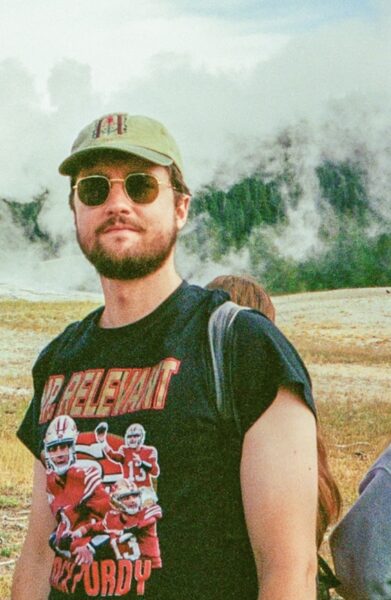
Joseph Kidney has published poems in Best Canadian Poetry 2024, Vallum, The Malahat Review, The Fiddlehead, The New Quarterly, PRISM, The Ex-Puritan, and Al-Araby Al-Jadeed (in Arabic translation). He won a National Magazine Award Gold Medal for Poetry, the Poem of the Year award from Arc, the Short Grain Contest from Grain, and The Young Buck Poetry Prize (now the Foster Poetry Prize) from CV2 for the best poem submitted by an author under 35. His poems can be seen on local buses through the Poetry in Transit program. Originally from BC, he is currently a lecturer at Stanford University.

Rob Taylor’s fifth poetry collection is Weather (Gaspereau Press, 2024).He lives with his family in Port Moody, BC. You can read more of his interviews on his website.